| General |
| Q. What can AgroLab do for Lawn Care Companies? |
A.
Please follow the link below for complete details AgroLab and Lawn Care Companies |
| Q. What should I know about pulling a soil sample? |
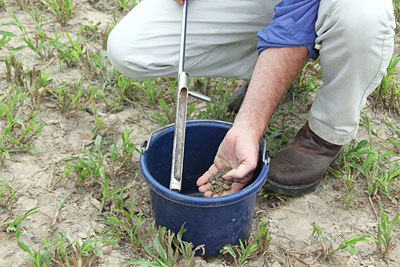
| A. Take soil samples at any convenient time. However, to receive an analysis and the recommendations early enough to enable getting the lime and fertilizer needed, it is best to sample in the Fall or early Spring. Areas selected for sampling should be as uniform as possible. Do not mix soils of differing color and/or texture. Dead furrows, eroded knolls, low spots and parts of a field where lime, manure, or fertilizer have been excessively applied or under applied should be avoided or sampled seperately.
For complete instructions, please follow the link below AgroLab Soil Sampling Instructions |
| Q. How do I interpret my Lawn or Garden Report? |
| A. Please follow the link below for complete instructions AgroLab Lawn & Garden Quick Reference Guide |
| Q. What methods are used for soil analysis and what can help me better understand the report? |
| A. Please follow the link below for a complete list of terms and interpretations. AgroLab Report Legend |
| Q. How do I take a plant sample? |
| A. Tissue samples should be collected from healthy plants distributed randomly across the field in question in order to create a representative sample. Plants that are under stress, diseased, or show signs of insect or mechanical damage should be avoided. Do not mix different species of fruit or cultivars into one sample. When collecting tissue samples, store them in a clean container such as a plastic pail or paper bag. At no point during the sampling or shipping process should samples be placed in sealed plastic bags. Plastic bags or other airtight containers will not allow the plant to dry and may cause decomposition. Please follow the link below for complete instructions. Tissue Sampling Fact Sheet |
| Q. What are some common conversions? |
| A. Please follow the link below to find some common conversions for different types of applications. AgroLab Common Conversions |
| Q. How does the FIV compare to AgroLab data? |
| A. The University of Delaware and Maryland use different ratings for interpreting soil test levels for Phosphorus (P), Potassium (K), Calcium (Ca), and Magnesium (Mg).
Please follow the link below to get the levels of Interpretation. FIV Quick Reference Guide |
| Q. What is the Phosphorus Saturation Ratio? |
| A. Please follow the link below for complete details on Phosphrous Saturation Ratio. Phosphorus Management and The Phosphorus Saturation Ratio |
| Q. What do I need to know about Stalk Nitrate results? |
| A. The end-of-season corn stalk nitrate test is a simple, inexpensive tool that can be used to assess the nitrogen (N) growing season.
Please follow the link below for our fact sheet on end-of-season corn stalk nitrate testing. End-of-Season Corn Stalk Nitrate Testing to Optimize Nitrogen Management |
| Q. How do I interpret Water tests for ponds? |
| A. Please follow the link below for complete instructions. Interpreting Water Tests for Ponds and Lakes |
| Q. How do I interpret water test results for poultry? |
| A. Please follow the link below for complete instructions Interpreting Water Test Results for Poultry |
| Q. How do I interpret my Water Irrigation Analysis? |
| A. Irrigation water quality is dependent on its chemical composition. The concentration of mineral constiuents in the water varies depending on the amount of soluble materials encountered by the water. These soluble constituents are called soluble salts. If soluble salts are high they may be detrimental to plants.
Please follow the link below for complete details Interpretation of Water Analysis |